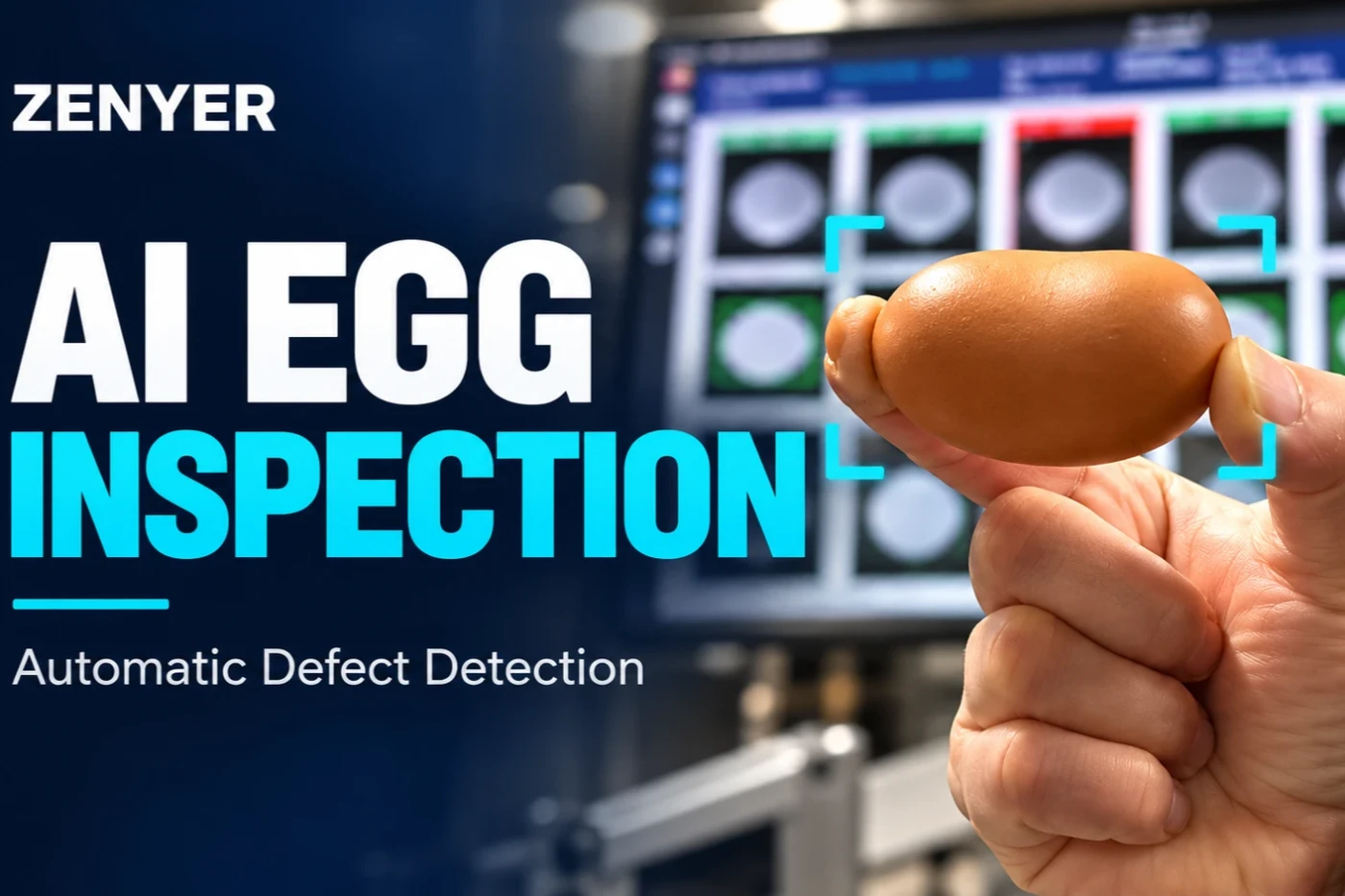
I. The egg industry, which is facing significant challenges due to manual inspections and operational bottlenecks
Entering many large egg processing plants, one can still see the egg inspection stations: workers use the built-in strong light from the inspection equipment to quickly examine the eggs on the conveyor belt and remove any defective eggs. This is the traditional egg inspection process.
But few people realize the inherent shortcomings of manual quality inspection:
Prolonged continuous monitoring inevitably leads to visual fatigue.
There are significant differences in the ability to detect fine cracks and minor stains during the initial period of employment and during times of fatigue;
It is difficult to establish a unified standard for determining whether defects in products are considered unacceptable among different workers.
For egg-producing companies, this is not just a matter of efficiency; it also poses a significant risk to quality control. If a cracked egg makes its way into the market, it could result in customer returns and claims for compensation at the least, or even damage to a brand's reputation that has been built over a decade. This is especially true for exported eggs, as the markets in Europe, America, and the Middle East have extremely strict requirements for the integrity of eggshells. Once a cracked egg is detected, the entire batch of goods may be rejected.
What's more challenging is that the detection of duck eggs and salted duck eggs is much more difficult than that of regular eggs. Duck egg shells are thicker and darker in color, which limits the effectiveness of traditional light-based inspection methods for identification. Salted duck eggs also have oil stains on their surfaces after being preserved, and these stains and cracks can easily be confused with each other, making it very difficult to distinguish them from regular eggs.
This is why more and more egg production companies are beginning to turn their attention to AI-based visual inspection technologies.
II. Where exactly does the “intelligence” of AI visual detection lie?
Many people think that AI visual inspection is just about simply taking pictures and making comparisons. The real advantage of a mature, industrial-grade AI visual system for egg inspection lies in its ability to transform quality control from a process that relies on human eyesight and judgment into a stable, standardized, and continuously operational automated process. This system works in conjunction with traditional x-ray inspection techniques to enhance the shortcomings in production line quality control.
1. Say goodbye to the fluctuations in manual quality inspection – the defect recognition standards remain consistent. The system is equipped with multi-angle industrial cameras and custom lighting sources, capturing images of eggshells from various angles as each egg passes through the inspection station. An AI model trained on a large dataset of egg samples can accurately detect flaws such as cracks, bruises, fecal stains, and residual egg liquid on the eggshell surface. The main difference from manual inspection is that human inspectors are affected by fatigue, mood, and experience, which can lead to inconsistent judgment; in contrast, the AI strictly follows the pre-set criteria established by the factory and will not make mistakes due to prolonged operation. Of course, the AI is not omnipotent: there are still limitations in its ability to detect extremely fine cracks, and the model needs to be continuously optimized based on actual production conditions.
2. Automatic quantification and grading of stains enable more precise sorting logic. The manual distinction of dirty eggs relies entirely on subjective judgment based on experience. AI vision can accurately calculate the area and location of stains and identify their types. Factories can preset rules to automatically direct the eggs: those with minor stains are sent for cleaning, while those that are severely damaged or unqualified are directly discarded. This integrated system, in conjunction with cleaning and sorting facilities, ensures precise sorting that meets the grading requirements of specific brand eggs and export orders.
3. Empowering the traditional egg inspection process to improve the efficiency of detecting internal defects: AI itself cannot penetrate the eggshell. Within the entire production line solution, the visual system works in conjunction with the light-transmitting egg inspection module to perform intelligent analysis on the images captured through the light. This helps in identifying internal issues such as blood spots, meat spots, obvious egg yolk discoloration, and abnormalities in the air chamber. It’s essentially like adding an intelligent analysis assistant to the traditional egg inspection process, which reduces the workload on the inspectors and lowers the risk of missing any internal defects.
4. Overcoming challenging inspection scenarios such as those involving duck eggs and salted duck eggs: Chicken eggshells have a clean base color, making them relatively easy to inspect; duck eggshells are darker in color, and salt frost and oil stains on the surface of salted duck eggs can easily cover up cracks, which poses a significant difficulty for manual inspection. AI models specifically trained for the inspection of duck eggs and salted duck eggs can effectively distinguish between salt frost, oil stains, and actual damage. In such complex scenarios, the accuracy of these models is significantly better than that of manual visual inspection, which is why many salted duck egg processing companies prefer to upgrade to visual inspection systems.
III. Let's do the math: Is AI detection really worth it?
The first reaction of many egg company owners was: “A device that costs hundreds of thousands of yuan is too expensive.”
But let’s do some real calculations:
The manual inspection system and the AI visual inspection system show significant differences in operational stability. After prolonged use, the detection capability of the manual inspection system declines significantly, with large standard fluctuations. When running continuously for 24 hours, the recognition and judgment criteria become inconsistent. The system's productivity is limited to the processing speed of a single person, making it necessary for multiple workers to work in shifts on high-speed production lines. For high-speed, multi-level production lines, the system can process over 100,000 items per hour. However, managing and recruiting personnel is challenging due to high staff turnover and long training periods for new employees. Reducing reliance on quality inspection staff means that only periodic inspections are required for rechecking products. During periods of fatigue, the risk of missed inspections increases, which can lead to customer complaints and claims. In contrast, the AI system provides continuous and stable screening, significantly reducing the risk of defects in large batches. |
Relying on human optimization and reduced customer complaints and losses, many customers with high-speed production lines can generally expect to recoup their investment within 2-3 years after the lines have stabilized. The specific payback period is affected by the production line's operating conditions, labor costs, and the structure of orders.
More importantly, the entry requirements for downstream customers are continuously being upgraded:
Large supermarkets and e-commerce platforms are gradually requiring suppliers to provide records related to egg product inspections.
The standards for the consistency of quality control in export orders are increasing year by year.
Under the trend of branded consumption, stable and controllable product quality control makes it easier to obtain a market premium.
The ability to perform automated AI visual inspections is becoming an important advantage for securing high-end, stable orders. In the fields of branded eggs and exports, a reliable automated quality control system has become a crucial requirement for establishing order partnerships.
IV. Technical Implementation: It's not just about buying a device and calling it a day
Many companies think that implementing AI detection simply means “buying a machine and installing it,” but only when they actually put it into use do they realize that there are many pitfalls involved.
Trap 1: The model is a “general-purpose” one and won’t recognize your data (or information).
Eggs, duck eggs, salted duck eggs, and free-range eggs... The colors, thicknesses, and textures of their shells vary greatly among different types. If a general AI model is applied directly, the error rate would be incredibly high.
A truly reliable supplier will train custom models specifically for your egg product category, breeding environment, and common types of defects.
Issue 2: Although the detection accuracy has improved, the associated processes (or “linkages”) cannot keep up with the increased accuracy.
If cracked eggs are detected, what then? If the device cannot work seamlessly with the front-end grading machines and removal systems, the detection process is simply useless.
AI visual inspection is not a stand-alone device; rather, it serves as the “brain” of the entire grading production line. It must work in conjunction with inkjet printers, graders, and palletizing robots to truly achieve fully automated quality control.
Issue 3: Slow after-sales response can result in losses of tens of thousands of yuan even if the service is suspended for just one day.
Egg processing lines typically operate 24 hours a day, and if there is a problem with the AI equipment, a shutdown of the line for even one day can result in losses of tens of thousands, or even hundreds of thousands of yuan.
When selecting a supplier, the speed of after-sales response is more important than the parameters listed in the table.
V. The Future Has Already Arrived: The “AIization” of the Egg Industry Has Just Begun
If the past decade can be described as the “era of scale” for China’s egg industry, characterized by the size of farms and the capacity of production, then the next decade will undoubtedly be the “era of quality control,” where the focus will be on who has the most accurate testing methods and the most stable product quality.
AI visual inspection is not about whether to implement it or not, but about when to implement it.
When your competitors have already reduced the missed detection rate to below 0.5% using AI, when customers start to ask actively, “Do you have AI detection equipment?”, and when “AI-based individual item inspection” is included as a contract clause for export orders—
The tide of technological substitution never waits for anyone to be ready.
About Zenyer Intelligence: As a professional manufacturer in the field of egg processing equipment in China, Zhenye Intelligence has been deeply involved in the field of egg grading and inspection for many years. The AI vision inspection system they have developed has been widely applied in egg processing lines for various types of eggs, including chicken eggs, duck eggs, and salted duck eggs. Together with Zhenye's high-speed graders, this system enables full automation of the entire process from egg inspection, grading, coding, to palletizing, helping egg companies to advance to a new stage of intelligent quality control.